THE HOTEL
THE ANDALUSIAN PATIO
An idea that has traveled through the centuries, continuing to surprise visitors to southern Spain today.
When Washington Irving arrived in Granada in 1829 and took up residence inside the Alhambra, it wasn’t the palaces or horseshoe arches that astonished him most. It was the constant murmur of water flowing through the courtyards—a sound that never stopped, day or night, as though the building itself had a heartbeat.
Centuries earlier, the Cordoban poet Ibn Zaydún had already described the garden as a place where time stands still and water preserves the memory of those who gaze upon it. That idea has traveled through the centuries, continuing to surprise visitors to southern Spain today. Sometimes it takes an outsider to put into words what generations of Sevillian families had always taken for granted: that a house without a patio is a house without its lungs—or its soul.


The Andalusian patio is far more than an architectural flourish. It is a remarkably sophisticated climate-control system whose origins can be traced back to Roman houses, refined during Al-Andalus, and preserved through the centuries because it simply works.
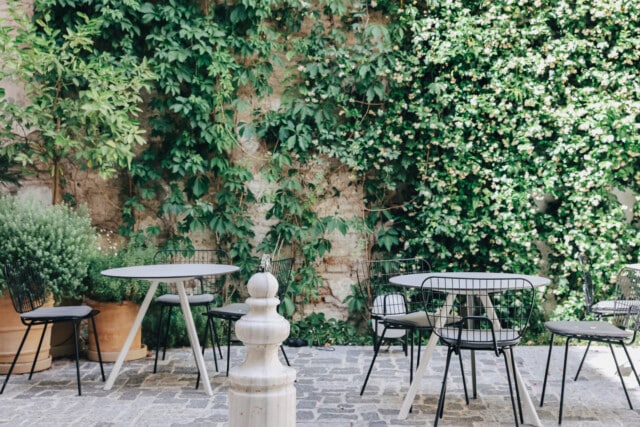
Its logic is both ancient and elegant: an open courtyard beneath the sky, enclosed by thick whitewashed walls that reflect rather than absorb the sun. Warm air rises and escapes above, while the coolness gathered overnight lingers close to the ground throughout the day. A fountain or cistern cools the air through evaporation, and rows of plants create a green filter between the harsh Andalusian sun and the shaded interior rooms.

It is, in essence, an air-conditioning system that requires no electricity—designed long before sustainability became part of our vocabulary. Federico García Lorca transformed that same idea into poetry in Diván del Tamarit, imagining gardens where water endlessly searches for a sea it will never reach.

“rows of plants create a green filter between the harsh Andalusian sun and the shaded interior rooms.”


The Heart of Everyday Life
The patio shaped more than architecture; it shaped the rhythm of daily life. Throughout the communal courtyards documented since the nineteenth century, several families shared a common space where meals were prepared, clothes were mended, children grew up together, and conversations drifted beneath rows of geraniums passed down from one generation to the next.
Neither entirely public nor entirely private, the patio formed a gentle threshold between the street and the home. Behind its wrought-iron gate, life could be glimpsed without ever being fully revealed. For centuries, much of southern Spain’s neighborhood life—and even its courtships—played out through these quiet moments of seeing without entering.

There is, however, a third dimension to the patio, one that is harder to measure but no less real: its symbolic meaning. The enclosed garden with water at its center is an idea inherited by Al-Andalus from even older traditions, where paradise was imagined as a cultivated, irrigated garden—a place of harmony set apart from the noise of the outside world.
The Andalusian patio brings that vision down to a human scale. Standing at its center and looking upward toward a rectangle of sky framed by tiled roofs remains, today as it was eight centuries ago, one of the Mediterranean world’s most enduring spatial experiences.


The Patio at Plácido y Grata
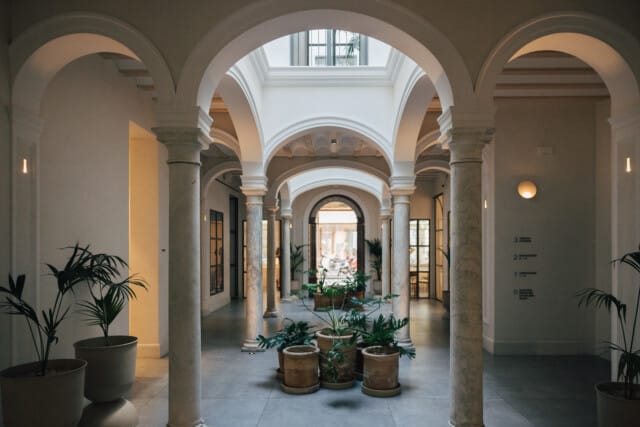
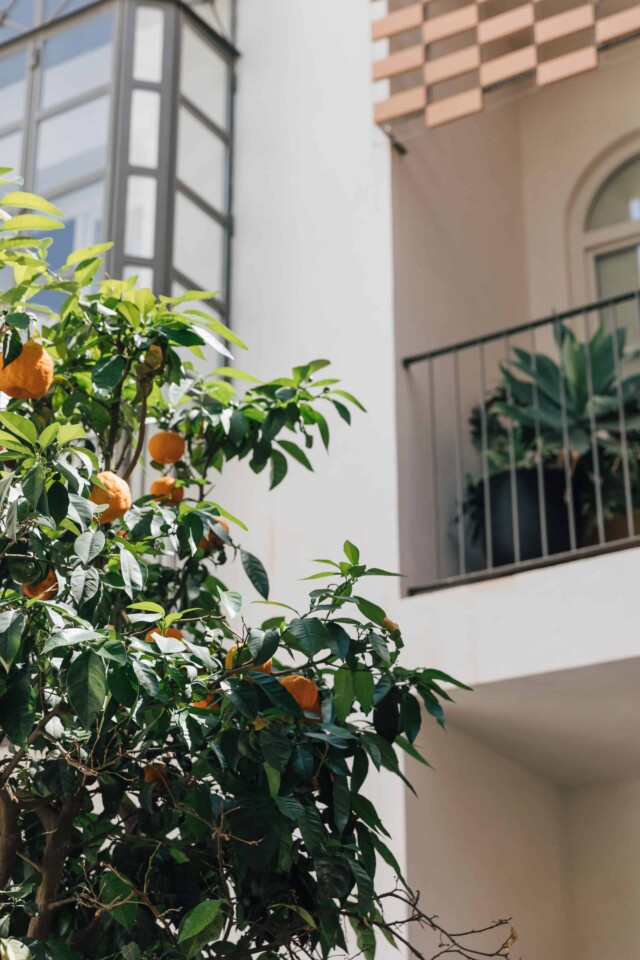
The patio at Plácido y Grata is rooted in these three overlapping traditions. Its orange trees provide shade and perfume during Seville’s long summer evenings, just as they have in Andalusian courtyards for centuries. At its center, water continues to serve the same purpose it did five hundred years ago: gently cooling the air before it flows into the surrounding rooms. Stone helps regulate temperature throughout the day, while whitewashed walls amplify the soft Mediterranean light, creating an atmosphere that feels naturally calm and restorative.
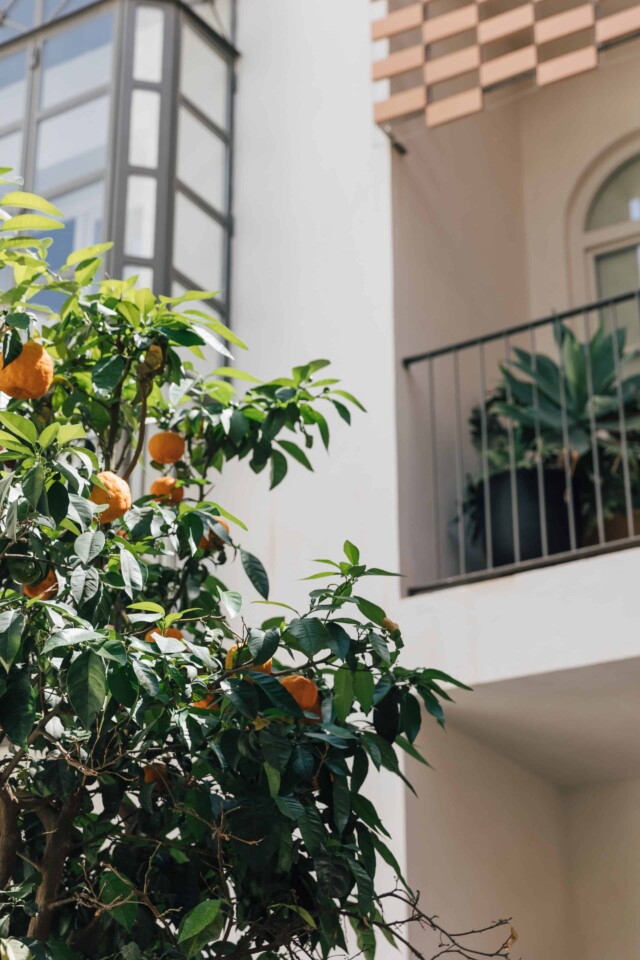
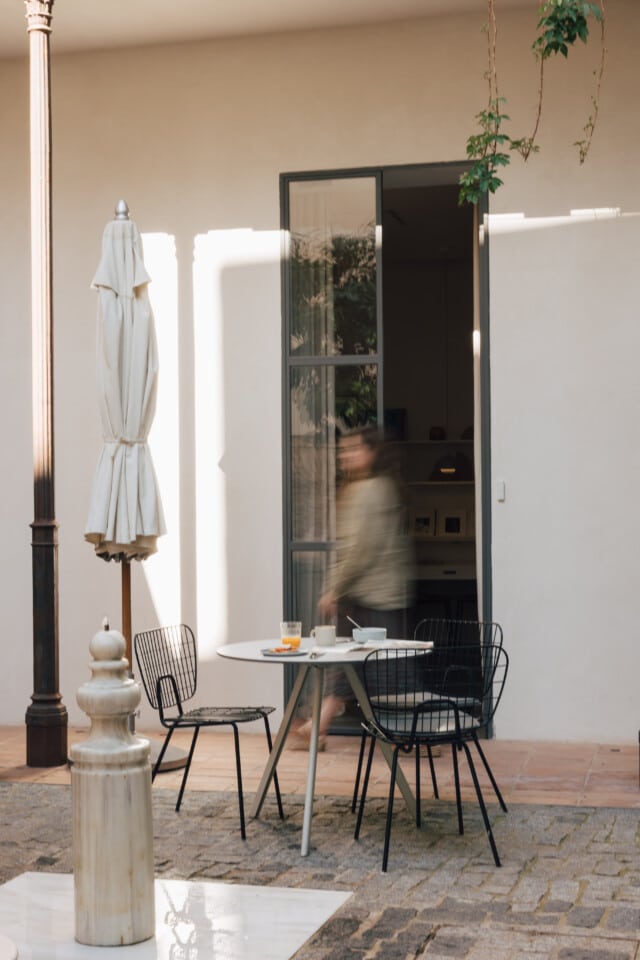
And within this space—designed centuries ago to soften the heat—is where well-being unfolds almost effortlessly. This is where someone comes downstairs early with a book. Where breakfast lingers into conversation. Where an afternoon coffee turns into an hour of quiet reading beneath the orange trees. There is no need to hurry in a place that was conceived, centuries ago, for precisely the opposite. The patio gathers the stillness of the morning—the aroma of freshly brewed coffee, the sound of low voices, the movement of water and shade—and gently carries it through the rest of the day.

Perhaps the most remarkable thing is how relevant this centuries-old architecture remains today. Seville is now one of Europe’s hottest cities, experiencing more days of extreme summer temperatures than almost anywhere else on the continent. Once again, the traditional patio becomes what it was always intended to be: the most comfortable room in the house when the heat is at its peak.
Plácido y Grata hasn’t reinvented this tradition. It has simply trusted a system that generations before us had already perfected, allowing life to unfold where it always has in this city: beneath an open rectangle of sky, with the gentle sound of water in the background, just as Ibn Zaydún once imagined it, just as Washington Irving heard it inside the Alhambra, and just as countless Sevillians still experience it on those August afternoons when the sun makes the streets impossible and the patio becomes the best place to be.