THE HOTEL
SOUTHERN LIGHT, NORTHERN CRAFT
Sevillian manor houses and Scandinavian design come together at Plácido y Grata through light, craftsmanship, and a shared philosophy of timeless design.
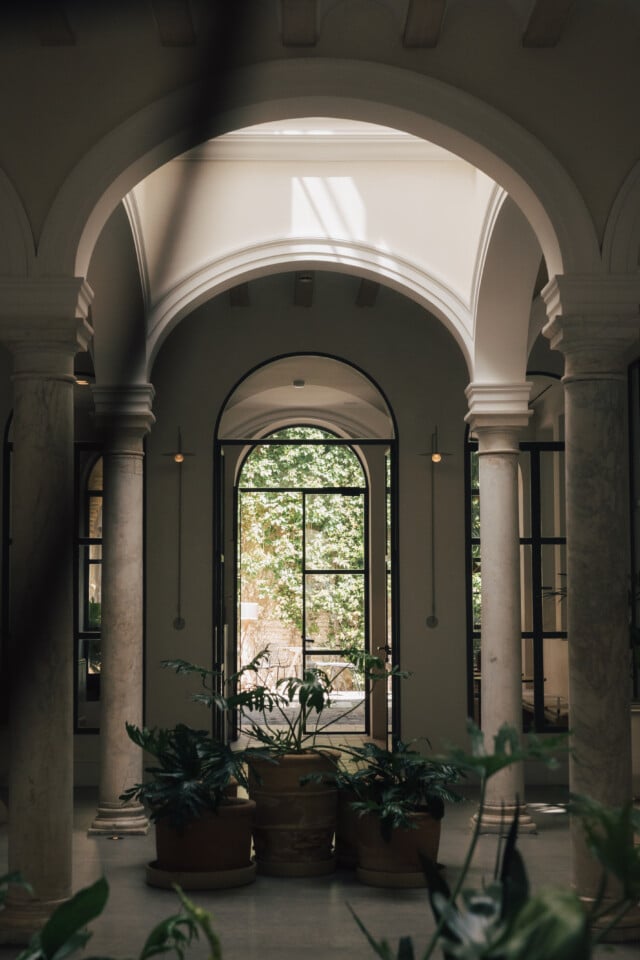
Cecilia Böhl de Faber was born in Switzerland, educated between Germany and France, and arrived in Andalusia as an adult carrying a surname that belonged to another climate. She wrote under the name Fernán Caballero and spent much of her career describing, with almost inventory-like precision, daily life inside nineteenth-century Sevillian houses: their reception rooms, their wrought-iron gates, the exact way light entered through a grille and settled at half height above the entrance hall. What’s curious is that it took a northern eye, shaped by a different light and a different language, to put into words what Seville had taken for granted for centuries. Something similar happens at Hotel Plácido y Grata: two distinct climates recognizing something essential in each other, with no need for translation.

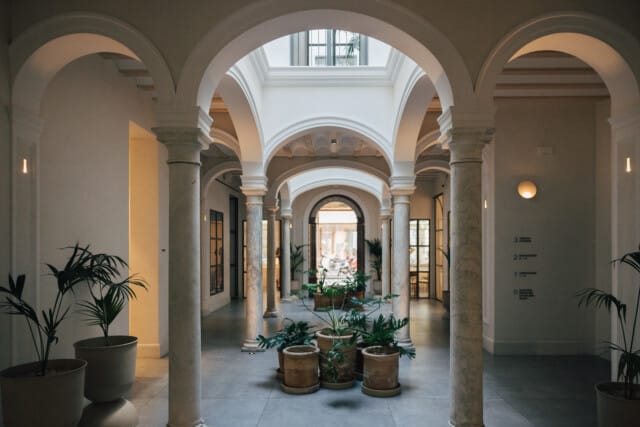
A nineteenth-century Sevillian señorial house, a grand bourgeois residence, was built starting from the street. First came the zaguán, the dim entrance corridor that served as both a filter and a stage set. Then the cancela, the pierced iron gate that announced the courtyard without fully surrendering it, a literal threshold between public and private that also, let’s be honest, functioned as a display case for social standing. Around that center sat the reception rooms, the grandest ones, and behind them, out of a visitor’s sight, the kitchen and the service quarters.


Upstairs, if the house had an upper floor, the family slept, away from the noise of the street. What matters here is everything that surrounded that center: the full sequence of rooms that turned a bourgeois home into a small domestic theater, built for fortunes made in olive oil, wine, or trade with the Americas, fortunes that needed to be shown without ever being spoken aloud.

Restraint Beneath the Ornament
In the early twentieth century, as Seville prepared for the Ibero-American Exposition, a group of architects led by Aníbal González looked backward and reinvented that language, giving rise to Sevillian Regionalism. It kept the exposed brick, the glazed tile, the wrought iron, the rounded arch, and carried them into new buildings with a logic that was, for its time, genuinely modern: using craft and material as identity. Beneath the ornament sits a sober, almost elemental structure that solves a construction problem by the most direct means available. That underlying restraint is also the key to everything that follows.

“That underlying restraint is also the key to everything that follows.”


Twentieth-century Scandinavian design starts from an entirely different problem and arrives, surprisingly, at the same answer. Where the South had an excess of light and needed to control it, the North had a scarcity of light and needed to capture it, and both cultures ended up obsessed with the same working material. In both cases, craft outranks ornament; the material shows itself rather than hiding. A cabinetmaker in Hälsingland and an ironworker in Triana would never have understood each other’s words, but they would have understood each other’s work at first glance.

The Same Material, Two Climates
That was the guiding principle behind Your Living Space Atelier‘s renovation of the building. The studio, led by a team of architects and interior designers, worked with Nordic furniture to adapt the rooms and spaces, making them welcoming and, above all, comfortable for guests. The zaguán still does its job as a filter between street and interior, only now that filter opens onto a clean-lined reception.


The old reception rooms, once built to impress, have become multi-purpose lounges and shared spaces meant for lingering rather than performing. The fifteen guest rooms retain the proportions and the high ceilings of a house never intended to lodge travelers, and that’s where the Nordic gesture shows most clearly, in the way oak, linen, and pared-down furniture pieces have been introduced without competing with an original coffered ceiling or molding.

What sets this kind of renovation apart from a simple decorating job is precisely that refusal to pick a side. The señorial house hasn’t been restored to freeze it in 1890, nor has any Nordic aesthetic been imposed to erase it. The two logics have been allowed to coexist because, at the bottom, they share the same work ethic: honest materials, visible craft, and an absence of unnecessary noise.

The señorial house and Nordic design don’t resemble each other because one influenced the other. They resemble each other because both arrived, by entirely different routes, at the same honest conclusion: that a well-made object, or a well-resolved space, doesn’t need to raise its voice. Fernán Caballero would have understood that immediately. She, too, came from another climate and learned to read this one without translating it.