TIME TO ENJOY
THE BOOK YOU’LL READ AT PLÁCIDO Y GRATA
There’s a way of preparing for a trip that has nothing to do with booking restaurants or checking the weather. It starts by opening a book. Letting someone who knew the place before you lend you their eyes for a few hours.
Seville had the good fortune to be a literary city long before it became a tourist destination. It has drawn in writers who arrived looking for something else and stayed without meaning to; it has given birth to poets who spent the rest of their lives trying to return. That leaves a trace. And that trace can shape a journey in ways no app ever will.

These are four books we’ve gathered with the guests of Plácido y Grata in mind. They’re not the most famous or the most obvious. They’re the ones that, we believe, change the way you see the city.

Before you arrive
Carmen — Prosper Mérimée (1845)
It helps to separate this novella from the opera that made it famous. Prosper Mérimée didn’t write a spectacle—he wrote a portrait. He came to Seville in 1830 with the sharp eye of an archaeologist (he was Inspector of Historical Monuments) and the sensibility of a Romantic writer who knows he’s witnessing something that won’t last forever.
His Carmen moves through streets that still exist. The tobacco factory where she works is now the University of Seville—that vast, orderly building that surprises anyone who doesn’t know what it once was. Reading Carmen before crossing its courtyards changes the experience. Not into a literary pilgrimage—that would be pretentious—but into a quiet conversation between the present and the 19th century that would otherwise never happen.
It’s a short book. You can read it in an afternoon. And it leaves you with an image of Seville that feels, in some ways, more precise than many things written after.

“A quiet conversation between the present and the 19th century that would otherwise never happen”

As I Walked Out One Midsummer Morning — Laurie Lee (1969)
British writer Laurie Lee walked across Andalusia in 1934 at nineteen, carrying a violin. The book he wrote about that journey has a strange quality: the prose seems made of the same material as the landscape it describes—light, heat, dust, and the sound of a language he doesn’t fully understand, but absorbs beneath the words.
Lee reached Seville at the end of summer and wrote about the city with that mix of wonder and precision only solo travelers seem to have. He’s not trying to confirm anything. He just looks.
Reading him before your trip won’t help you plan your itinerary—but it will prepare your senses. And in a city like Seville, that matters more.

To read in the hotel patio
Solitudes, Galleries and Other Poems — Antonio Machado (1907)
Antonio Machado was born in the Palacio de las Dueñas, in central Seville, in 1875. His early poetry—the poems in Solitudes—is made of patios, fountains, long afternoons, and that specific melancholy produced by light as it begins to fade. In many ways, it’s Sevillian poetry, even when it doesn’t explicitly speak of Seville.


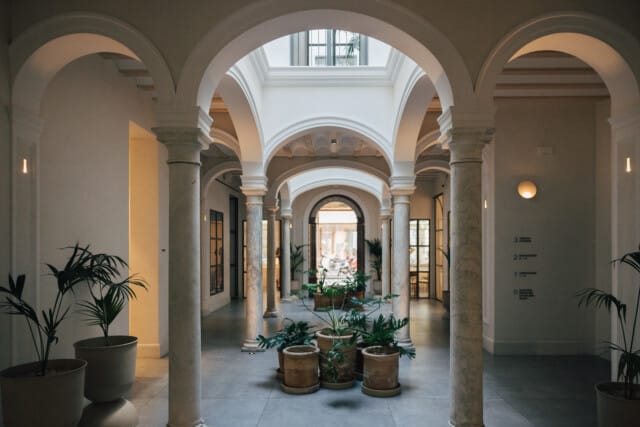
There’s something almost circular about reading these poems in the patio of Plácido y Grata. Water, columns, the quiet of mid-morning—the very elements Machado turned into symbols are here, tangible, in front of you. Each poem is brief. You can read one, set the book down, and simply look. That’s exactly what it asks for.
You don’t need to be a poetry reader for it to work. You just need a bit of stillness—and, staying at our hotel in Seville, that’s the easiest thing to find.

To take back home
Reality and Desire — Luis Cernuda (1936–1964)
Luis Cernuda was born in Seville in 1902 and spent the rest of his life unable to return. He left during the Spanish Civil War and died in Mexico in 1963. His collected work, Reality and Desire, which he expanded over decades, is—among other things—a long elegy for his city: for Seville’s light, for the Guadalquivir River, for the gardens where he was young.
There are poems in this book that read differently after you’ve been to Seville. Cernuda names things the traveler already knows—not monuments, but sensations: the quality of air at a certain hour, the weight of a summer afternoon, the silence of courtyards.
This is the book to open once you’re back home and the trip begins to blur. Cernuda kept it alive through thirty years of exile. He knew something about how that’s done.